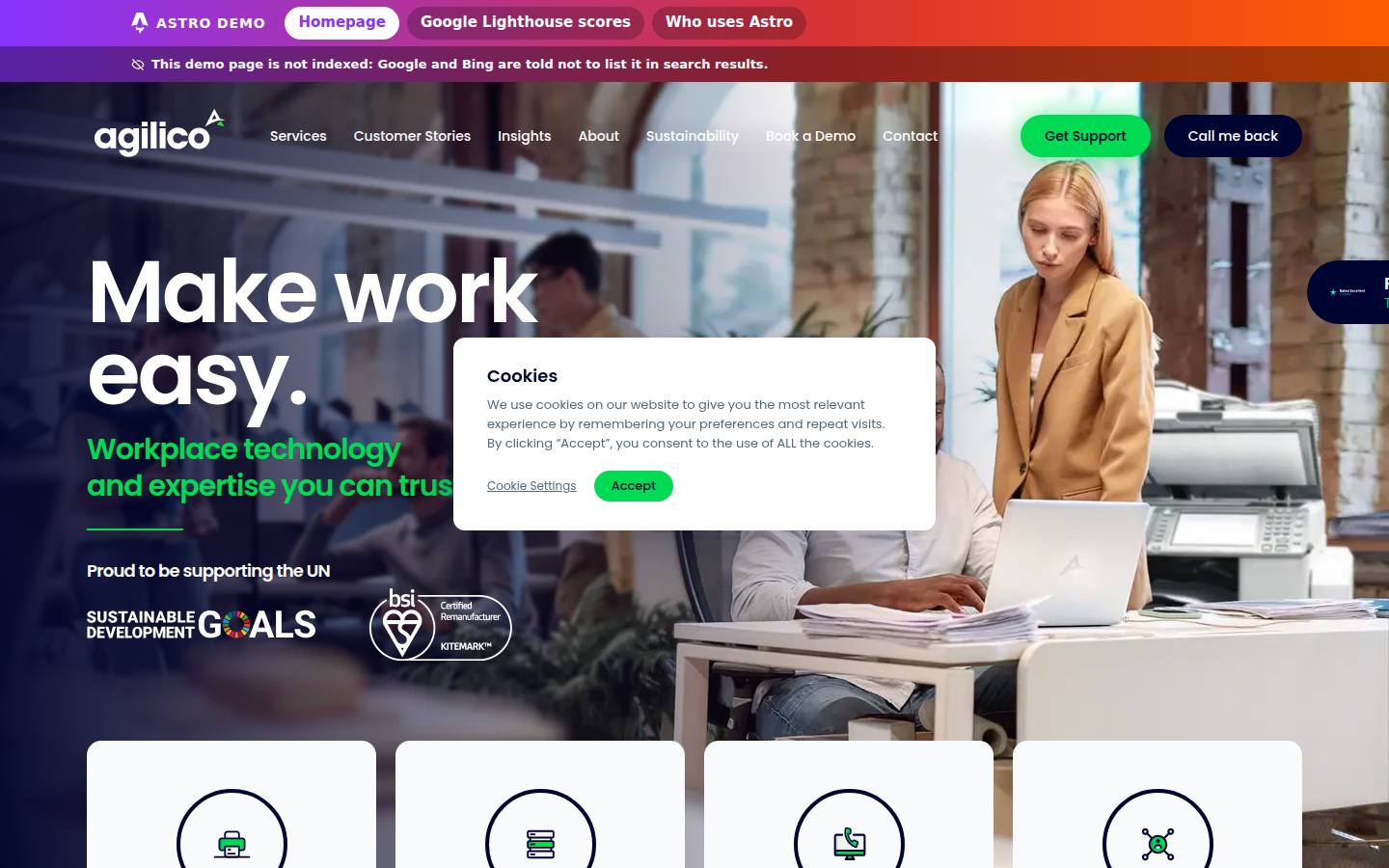

Agilico homepage

WordPress today vs Astro

The same homepage, measured side by side with Google Lighthouse, the test Google uses to score page speed and quality. Measured 30 September 2026 at 13:15, UK time.

Today on WordPress

agilico.co.uk ↗

Today on WordPress: homepage screenshot
43
Performance
85
Accessibility
96
Best Practices
100
SEO
Main content visible
16.6 s
First thing on screen
5.0 s
Page visibly complete
8.7 s
Frozen to taps and clicks
590 ms
Layout jumping
0.02

The same page on Astro

this demo ↗
The same page on Astro: homepage screenshot
100
Performance
99
Accessibility
100
Best Practices
100
SEO
Main content visible
1.4 s
First thing on screen
1.1 s
Page visibly complete
1.1 s
Frozen to taps and clicks
0 ms
Layout jumping
0.01

What Astro changes on a phone

+57Performance points
+14Accessibility points
+4Best Practices points
0SEO points
92% fasterMain content visible
87% fasterPage visibly complete

Today on WordPress

agilico.co.uk ↗
Today on WordPress: homepage screenshot
48
Performance
85
Accessibility
96
Best Practices
100
SEO
Main content visible
3.5 s
First thing on screen
800 ms
Page visibly complete
2.9 s
Frozen to taps and clicks
570 ms
Layout jumping
0.09

The same page on Astro

this demo ↗
The same page on Astro: homepage screenshot
100
Performance
99
Accessibility
100
Best Practices
100
SEO
Main content visible
400 ms
First thing on screen
300 ms
Page visibly complete
400 ms
Frozen to taps and clicks
0 ms
Layout jumping
0.01

What Astro changes on a desktop

+52Performance points
+14Accessibility points
+4Best Practices points
0SEO points
89% fasterMain content visible
86% fasterPage visibly complete

Why move

Risk today, and what replaces it

The risk of staying on WordPress

  • Most weak points come from plugins. Patchstack found that 91% of new WordPress vulnerabilities found in 2025 were in plugins, not in WordPress itself. Every plugin is another supplier’s code running on your server.
  • Every update is an untested change. WordPress, the theme and each plugin update on their own schedules. Any update can add scripts to every page, change how pages load or clash with another plugin, so speed and layout can drop without anyone editing the site.
  • Keeping it fast is a permanent job. Holding the scores means re-testing after every update, for as long as the site runs. Without that, speed can slip away unnoticed.

What we saw on agilico.co.uk (30 September 2026)

  • WordPress 7.0.5. The latest release is 7.1.2, and the latest fix on its own 7.0 line is 7.0.6
  • 8 plugins visible in the homepage code: LoftLoader Pro, Salient Core, Salient Social, Salient Portfolio, WPBakery (Salient edition), Popup Maker, GDPR Cookie Consent and Blayney Add-ons
  • Page builder WPBakery 6.13.1; WPBakery’s current line is 8.x
  • The WordPress admin login page is open to anyone on the internet
  • The XML-RPC remote-access endpoint answers requests
  • At least seven tracking tools load on every visit, including Google Tag Manager, Google Analytics, Hotjar, Microsoft Clarity, ZoomInfo, Demandbase and Act-On

Publicly visible facts from the live homepage. They show how much is exposed and maintained, not that the site has been attacked.

What Astro gives you

  • Fast by design, not by tuning. Pages are built in advance and send no JavaScript unless a part of the page needs it. The scores above were measured, not promised.
  • No plugins, no server code to patch. There is no database, admin login or plugin on the live site for anyone to attack.
  • Speed checked before every release. Every change is tested with the same Google Lighthouse and look-alike checks shown on this page before it goes live, so speed cannot drift quietly.

What Cloudflare gives you

  • DNS: the foundation. Your domain and email records run on Cloudflare’s DNS, which Cloudflare describes as “consistently measured as one of the fastest” in the world.
  • Firewall in front of the site. Cloudflare’s web application firewall is available on all plans; its Free Managed Ruleset gives “protection against high-impact and widely exploited vulnerabilities”.
  • Attack and bot protection, always on. DDoS protection is “always on for all Cloudflare plans”, and Bot Fight Mode on the free plan challenges known bad bots.
  • One provider for the full service. DNS, firewall, delivery from data centres near every visitor, and hosting (Cloudflare Pages, which runs this demo) in one place.

Sources: Patchstack: State of WordPress Security in 2026 · Cloudflare DNS · Cloudflare WAF managed rules · Cloudflare security features (checked 30 September 2026).

What we would build for Agilico

Three layers, each doing one job

WordPress does everything in one place: pages, database, plugins, images and security. Here each job goes to a specialist, and the content layer is only added when it earns its place.

  1. 3. Content, when neededContent management (CMS), digital assets (DAM) and product information (PIM)
    • CMS: your team edits the site. An editing workspace built around your content, with live preview: “content teams see changes instantly without waiting for builds or deployments.” Official Astro integration.
    • DAM: one home for images and files. Sanity Media Library lets teams “manage assets in a centralized place… then use them across your entire organization.”
    • PIM: one source for product data. Holds products, variants and their images together, and can “connect all product information from all your sources like ERPs, MDM, PLMs and unify all information in one place.”

    When: Add it only when you need it: CMS if your team edits pages often; DAM for a large image and document library; PIM for a product catalogue.

  2. 2. WebsiteThe pages your visitors see
    • Ready-made pages. Every page is built in advance, so there is nothing to assemble when a visitor arrives. That is where the scores above come from.
    • No code visitors don’t need. Astro sends no JavaScript to the browser unless a part of the page needs it.
    • Nothing to hack on the server. No login page, database or plugins sit behind the Agilico site.

    When: Always. It replaces WordPress for the pages.

  3. 1. FoundationCloudflareDNS, global network, security and hosting
    • Your domain’s address book (DNS). Cloudflare runs the DNS that points your domain and email to the right places. Cloudflare describes its DNS as “consistently measured as one of the fastest” in the world, and it is free.
    • Served close to every visitor. Pages are delivered from a Cloudflare data centre near each visitor, not from one server in one building.
    • Firewall and attack protection. A web application firewall filters attacks before they reach the site, and DDoS protection (against floods of fake traffic) is always on.
    • Hosting. This demo already runs on Cloudflare Pages: no web server, database or plugins to patch.

    When: Always. Every site starts here.

Vendor statements quoted from: Cloudflare DNS · Sanity and Astro · Sanity Media Library · Sanity for PIM (checked 30 September 2026).

How we measured, and exactly what is different on the Astro version

Raw results: mobile WordPress: 1 2 3 4 5 · mobile Astro: 1 2 3 4 5 · desktop WordPress: 1 2 3 4 5 · desktop Astro: 1 2 3 4 5 · Re-run yourself: WordPress site · Astro version